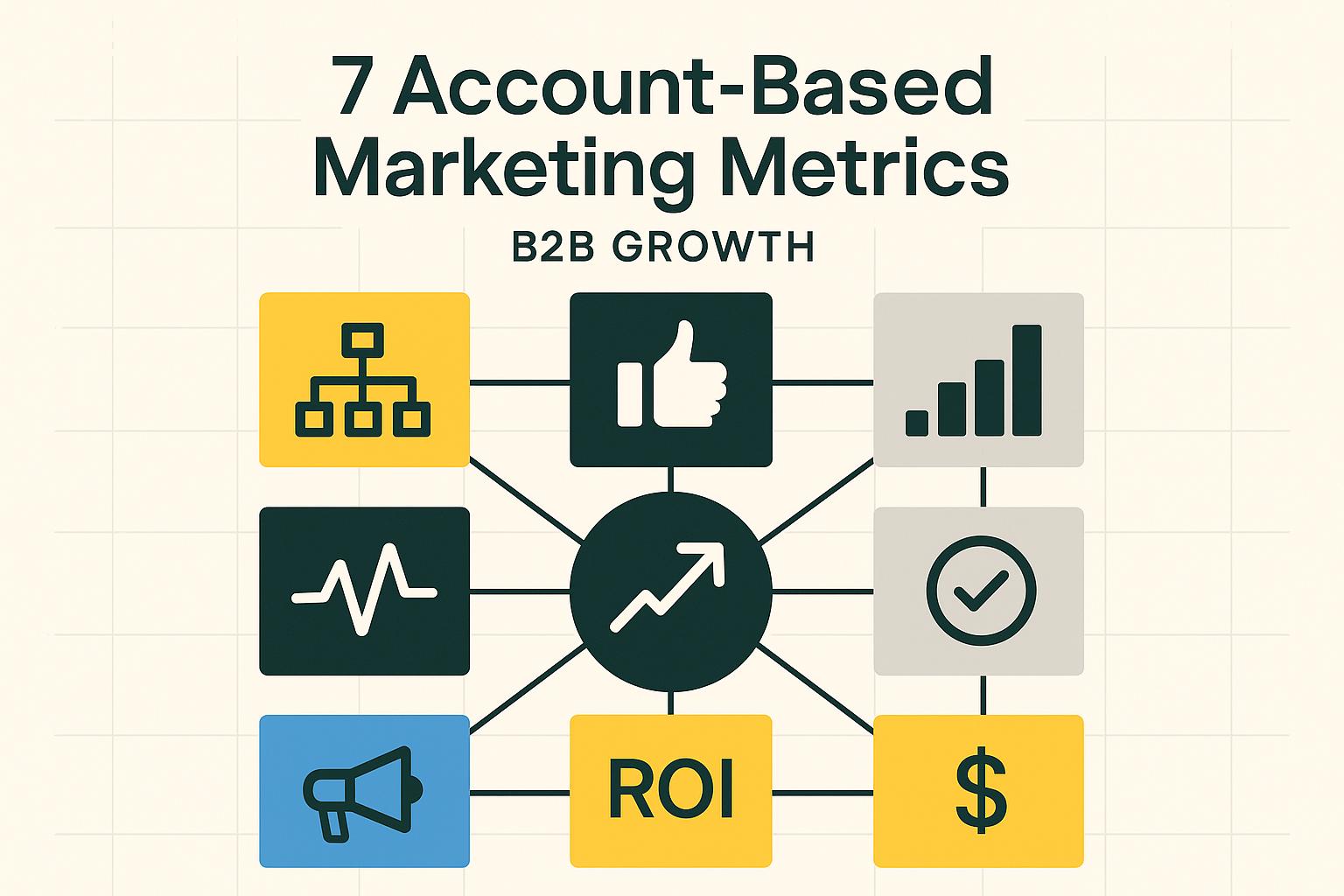


Account-Based Marketing (ABM) focuses on high-value accounts, requiring specific metrics to measure success effectively. Unlike traditional lead generation, ABM tracks account-level engagement to evaluate how well you're connecting with decision-makers and advancing them through the sales pipeline. Here's what you need to know:
- Account Engagement Metrics: Track total interactions (e.g., email clicks, content downloads) and analyze activity at the account level, not just individual leads.
- Pipeline Speed Metrics: Measure how quickly accounts move through sales stages and identify bottlenecks to improve pipeline velocity.
- Contact Reach: Focus on engaging all stakeholders within an account, ensuring strong decision-maker coverage and accurate contact data.
- Conversion Rates: Monitor stage-by-stage transitions (e.g., MQA to SQA) to identify gaps and improve deal creation.
- Customer Value: Use metrics like Customer Lifetime Value (CLV) to assess long-term account profitability and growth potential.
Automation tools like HubSpot and Salesforce simplify tracking and reporting, consolidating data to help refine your ABM strategies. By focusing on these metrics, you can directly tie marketing efforts to revenue and improve overall campaign performance.
Account Based Marketing Metrics That Matter
Account Engagement Metrics
Account engagement metrics help measure how well target accounts are connecting with your marketing efforts, offering a glimpse into their genuine buying intent.
Total Interaction Tracking
To understand engagement, it’s essential to track every touchpoint across all channels - whether it’s a visit to your website, an email click, a content download, attending a webinar, or engaging on social media. Together, these interactions create a comprehensive view of account activity.
Not all interactions carry the same weight. For instance, downloading a whitepaper signals more intent than merely opening an email, while attending a product demo suggests even stronger interest. By analyzing these touchpoints collectively, you can distinguish between accounts actively exploring solutions and those with only casual interest.
Pay attention to both how often and how recently interactions occur. For example, 15 touchpoints over two weeks indicate much higher engagement than the same number spread over six months. By aggregating these interactions, you’ll uncover a clearer picture of an account’s overall behavior.
Account-Level Data Analysis
Looking at interactions collectively at the account level can reveal patterns that individual tracking might miss. This broader view captures the full scope of engagement and highlights organizational interest.
Take an enterprise account as an example: the IT director downloads technical specs, the CFO reviews pricing, and the CEO explores case studies. While each action might seem minor on its own, together they signal significant interest from the organization as a whole.
This analysis also helps you understand how engagement is distributed within an account. Some accounts might show activity from just one or two individuals, while others display involvement from multiple roles across the organization. Accounts with broader participation often indicate a more advanced buying process and a higher likelihood of conversion.
Tracking engagement velocity - how quickly activity is increasing or decreasing - adds another layer of insight. A sudden surge in activity might suggest an account is entering a formal buying process, while declining engagement could signal the need for re-engagement strategies.
Using Data to Improve Campaigns
These engagement insights aren’t just numbers - they’re tools to refine your campaigns. Reviewing engagement data regularly allows you to identify which content, channels, and messages are effectively moving accounts forward.
For instance, if accounts that eventually convert tend to engage with specific case studies or technical resources early on, you can prioritize promoting these materials to new prospects. Similarly, understanding the ideal number and sequence of touchpoints can help fine-tune your nurturing cadence.
Timing also plays a critical role. Engagement data can help pinpoint the best times to reach out, with patterns often varying by industry. Customizing delivery timing for different account segments can significantly improve results.
Real-time engagement scoring adds another dimension. If an account’s activity drops below a certain threshold, automated workflows can trigger re-engagement campaigns. On the other hand, a sudden spike in activity might warrant faster nurturing or even direct outreach from sales.
The goal is to set clear engagement benchmarks for each stage of the account journey and continuously compare actual performance against these standards. This ensures your account-based marketing (ABM) campaigns evolve based on what truly drives results, rather than relying on assumptions about prospect behavior.
Account Coverage and Contact Reach
Engagement metrics are great for showing account activity, but they only tell part of the story. To move deals forward and speed up your pipeline, you need solid account coverage and accurate contact data. Why? Because reaching the right people - especially decision-makers - can make or break your progress. Let’s dive into how to map key contacts and keep your data in top shape.
Key Contact Tracking
If you want strong account coverage, start by mapping out the entire decision-making team for each target account. In B2B sales, buying decisions often involve several stakeholders. Focusing on just one or two contacts might leave you without the influence you need to seal the deal.
Identify the key roles in the buying committee. Each role has its own priorities and concerns, so tailoring your approach to address their specific needs is essential. For example, IT might care about integration, while finance is focused on ROI.
Want to measure your progress? Keep an eye on your contact penetration rate. For instance, if there are eight decision-makers in an account and you’ve engaged three, your penetration rate is 37.5%. Higher rates often mean accounts move faster through the pipeline and close more successfully.
But it’s not just about quantity. The quality of your contacts matters, too. A connection with a C-level executive can carry more weight than multiple connections with lower-level employees. And don’t underestimate the value of advocates at different levels - they can champion your solution internally.
Make sure your outreach spans all key departments, like IT, finance, operations, and legal. Missing a department could lead to roadblocks later. Timing is also critical. Building relationships with stakeholders early in the process often leads to shorter sales cycles. Waiting until later stages can result in delays or unexpected objections.
Contact Information Quality
Once you’ve identified your key contacts, the next step is ensuring their information is accurate. Without reliable data, even the best outreach strategies can fall flat.
Start by verifying the basics: email addresses, job titles, and company affiliations. Outdated data - like emails that bounce back - can hurt your efforts. Complete contact records are crucial for personalization, so include details like phone numbers, LinkedIn profiles, job roles, and reporting structures.
Pay attention to response rates as a way to gauge your data quality. If your open or connection rates drop below industry benchmarks, it might be time to update your records. Fresh, verified data tends to perform better than older, unverified information.
Where you get your data matters, too. Information collected directly from contacts - like through event registrations or form fills - is usually more reliable than third-party lists. Also, prioritize recent data, as it’s more likely to be accurate.
Keep an eye on changes in your contacts’ roles. Promotions, job changes, or departures can quickly make your contact mapping outdated. Setting up alerts for role changes can help you stay ahead, and maintaining relationships with contacts who move to new companies can open doors for future opportunities.
In short, investing in accurate, up-to-date contact data doesn’t just improve your engagement rates - it can also help you move deals through the pipeline faster.
Pipeline Speed Metrics
Once you’ve secured strong account coverage and reliable contact data, the next step is to focus on how quickly accounts move through your sales process. Pinpointing bottlenecks and speeding up slow stages can make a big difference in driving revenue. The faster you transition qualified accounts from initial engagement to closed deals, the better your outcomes. A closer look at how accounts progress through individual sales stages can help refine your strategy.
Sales Stage Movement and Cycle Time
Understanding how long accounts spend in each stage of your sales process is key to fine-tuning your ABM lead nurturing efforts. While the average deal cycle time is a helpful starting point, digging deeper into the time spent in specific stages - and across various account types - can reveal where improvements are needed.
Track the number of days accounts take to move between stages. For example, measure the time from Marketing Qualified Account (MQA) to Sales Qualified Account (SQA), and from SQA to opportunity. This detailed tracking can highlight which stages are running smoothly and which ones need extra attention.
Different account tiers often have varying cycle lengths. By tracking these separately, you can avoid setting unrealistic expectations and better align your strategies to the needs of each tier.
Keep an eye on accounts that are taking longer than usual in specific stages. These delays could signal issues like missing decision-makers or the need for additional information. Setting clear benchmarks helps you identify when deals are stalling and when it’s time to step in.
On the flip side, studying accelerated deals can provide valuable insights. If certain accounts are moving faster than expected, dig into the reasons - was it a well-timed piece of content, a productive meeting with a key stakeholder, or perhaps competitive urgency? These insights can inform strategies to boost overall pipeline speed.
Fixing Process Slowdowns
Once you’ve identified slowdowns in your pipeline, the next step is to address them head-on. The goal is to align your nurturing tactics with the specific challenges at each stage of the process.
One common issue is content gaps. If a particular stage consistently slows down, evaluate whether additional resources - like technical guides, ROI calculators, or relevant case studies - could help move accounts forward. Take a close look at your content library to ensure every stage is well-supported.
Another frequent cause of delays is a lack of engagement with all key decision-makers. If deals lose momentum after initial interest, it might be because not all stakeholders are involved. Use your contact data to expand outreach and ensure the entire buying committee is engaged, which can help speed things up.
Automation can also play a big role in keeping the pipeline moving. For instance, set up automated emails triggered by a drop in account activity. These emails could include tailored case studies, industry insights, or exclusive event invitations to re-engage dormant accounts.
Smooth transitions between sales and marketing are equally important. Clear handoff processes and prompt follow-ups ensure no momentum is lost during these critical stages. Even brief delays in team coordination can disrupt progress.
Lastly, consider implementing regular deal reviews for accounts stuck in prolonged stages. Bringing both sales and marketing teams together for these reviews can uncover hidden issues and help develop strategies to re-engage those accounts effectively.
Conversion Rates and Deal Creation
Once you've improved your pipeline speed, the next step is to measure how well your ABM campaigns are turning engagement into revenue. Conversion metrics help you understand which strategies are driving results and where accounts might be falling off the radar. By tracking conversion rates at each stage of the funnel, you can uncover actionable insights and pinpoint exactly where potential opportunities are slipping away.
It's important to note that not all engagement leads to sales opportunities. For example, an account might engage with your content, attend webinars, and download resources but still fail to transition into a qualified opportunity. By measuring conversion rates between each stage, you can identify these gaps and make adjustments to your approach. Breaking down each conversion point further helps you address specific areas where drop-offs occur.
Stage-by-Stage Conversion Tracking
Tracking conversion rates at every stage of the funnel is key to spotting opportunities for improvement. Pay close attention to the points where accounts either move forward or stall:
- MQA to SQA conversion: This shows how well your marketing efforts are identifying accounts that sales teams see as worth pursuing.
- SQA to Opportunity conversion: This reveals how effectively sales teams are turning qualified accounts into active deals.
- Opportunity to Closed-Won conversion: This highlights how well your nurturing strategies are supporting accounts through the final stages of the sales process.
- Time-based conversion tracking: This doesn't just measure if accounts convert but also tracks how quickly they move between stages.
It's also a good idea to track conversion rates by account tier. For instance, enterprise accounts might take longer to convert but often bring higher value, while mid-market accounts may move faster. Quick conversions could point to a strong product-market fit or an urgent business need, whereas slower conversions might indicate the need for additional nurturing.
Campaign Performance Breakdown
Beyond tracking stage transitions, it's essential to evaluate how individual campaigns are performing. Breaking down conversion metrics by campaign type can help you refine your strategy and focus on what works best:
- Content-based campaigns: Identify which types of content drive the highest conversions so you can prioritize creating more of what resonates.
- Multi-touch campaign analysis: Understand how different combinations of campaigns influence conversion rates, as ABM often requires multiple touchpoints.
- Channel-specific performance: Compare how well LinkedIn ads, direct mail, or webinar campaigns convert.
- Personalization impact: Measure the difference in conversion rates between highly personalized campaigns and more general approaches.
- Attribution modeling: Use multi-touch attribution to determine which campaigns contribute most to conversions.
- A/B testing: Regularly test elements like subject lines, content formats, and timing to improve conversion rates.
Cohort analysis can also be a valuable tool. By grouping accounts based on when they first engaged with specific campaigns, you can track their conversion journey over time. This approach gives you a clearer picture of the long-term effectiveness of your nurturing strategies.
sbb-itb-7f1e12d
Customer Value and Account Growth
Conversion rates give you a snapshot of how well your ABM campaigns are performing in the short term. But if you want to measure true success, you need to focus on the long-term value each account brings to your business. Metrics that track customer value help shift your attention beyond the initial sale, emphasizing the importance of building lasting relationships that drive revenue over time.
What makes ABM so powerful is its emphasis on high-value accounts with the potential for ongoing growth. By keeping an eye on customer value metrics, you can pinpoint which accounts deserve more attention and which strategies are working to secure long-term success. This insight is essential for allocating resources wisely and planning future campaigns.
Customer Lifetime Value (CLV)
Customer Lifetime Value (CLV) is a key metric that estimates the total revenue you can expect to generate from a single customer throughout your relationship with them [1]. In ABM, this measurement is critical because it shows whether your investment in detailed, personalized campaigns is delivering returns over time.
ABM plays a big role in increasing CLV by strengthening relationships that last well beyond the first sale, particularly with high-value accounts [1]. When you’re pouring resources into personalized campaigns, it’s crucial to ensure those accounts bring in enough revenue to make the investment worthwhile. A high CLV is a strong indicator that your ABM efforts are successfully building loyalty and deepening customer connections [2].
To calculate CLV, multiply the average deal value by the average customer lifespan [2]. For example, if an ABM account typically generates $50,000 per year and remains a customer for five years, the CLV would be $250,000.
To get started, analyze the total revenue generated specifically from accounts targeted through ABM [4]. Look at how long these accounts typically stay with your business [4]. Tracking CLV growth over time gives you a solid sense of your company’s overall health [1]. You can also compare your CLV to industry benchmarks for additional context [1]. Don’t forget to monitor your Account Churn Rate alongside CLV - lower churn rates suggest that your ABM strategies are working to retain and satisfy your most important accounts [2].
Marketing Automation for Metric Tracking
Tracking ABM metrics manually across multiple platforms can feel like a never-ending chore, especially when managing high-value accounts. That’s where marketing automation platforms come in. These tools consolidate your data, giving you the ability to focus on what really matters - turning raw numbers into actionable insights that improve ABM outcomes. With automation, you can streamline data management and free up time for strategic decision-making.
ABM campaigns generate a mountain of data - from email clicks and website visits to content downloads and sales activities. Without automation, you’ll find yourself buried in the task of gathering data rather than analyzing it. Marketing automation platforms take care of the heavy lifting by collecting and organizing this data, allowing your team to concentrate on optimizing strategies that drive results.
Centralized Data and Reporting
Platforms like HubSpot and Salesforce take centralized data management to the next level.
- HubSpot: By integrating marketing, sales, and service data, HubSpot provides a full view of an account’s journey - from the first website visit to closing the deal and beyond. Engagement data is automatically captured across all touchpoints, eliminating the need for manual entry. This gives you a clear picture of how accounts interact with your content.
- Salesforce: Known for its ability to handle complex account structures, Salesforce excels in managing large enterprise accounts with multiple contacts. Its Marketing Cloud and Sales Cloud integration enables custom dashboards that track the ABM metrics most relevant to your goals. Whether it’s pipeline velocity, conversion rates, or engagement scores, Salesforce delivers the numbers you need to make informed decisions.
Both platforms offer real-time alerts for key actions, like when a high-value account visits your pricing page or downloads a case study. This instant visibility allows your sales team to act quickly on buying signals. Beyond basic metrics, these tools enable custom reporting to uncover trends within specific account segments. For example, you might find that enterprise healthcare accounts engage more with video content, while mid-market manufacturers prefer in-depth whitepapers.
With the right automation, account-level reporting becomes much more insightful. Instead of focusing on individual leads, you can analyze how entire buying committees interact with your content. This broader perspective helps you distinguish between accounts that are genuinely warming up versus those with only one engaged contact. Centralized reporting turns raw data into actionable insights, accelerating account progression - a critical objective in ABM.
LaviPrime's Automation Services
While platforms like HubSpot and Salesforce offer robust tools, unlocking their full potential often requires expert configuration. That’s where LaviPrime steps in. Specializing in optimizing tech stacks for ABM, LaviPrime ensures your automation setup delivers meaningful insights - not just more data to sift through.
Through their ABM The Right Way service, LaviPrime helps businesses implement systems that track the metrics that matter most. This includes designing account scoring models, setting up automated reporting dashboards, and creating workflows that alert your team to critical account activities.
A key part of their approach is seamless integration. LaviPrime ensures your CRM and marketing tools work together smoothly, creating a unified view of account engagement. This eliminates data silos that can lead to missed opportunities or redundant efforts.
Process optimization is another cornerstone of their service. LaviPrime works closely with your team to define metrics clearly, automate data collection, and establish reporting schedules that align everyone on ABM performance. Their hands-on support ensures you’re not left guessing when it comes to complex integrations or configurations. As your ABM strategy evolves, LaviPrime continues to refine your tracking systems, making sure they grow alongside your account portfolio.
Key Points for ABM Metric Success
Effective measurement is the backbone of improving every stage of your ABM strategy. Unlike traditional demand generation, which prioritizes lead volume, ABM focuses on tracking account-level engagement and how accounts progress through your sales funnel. This shift requires a mindset centered on quality over quantity.
Here’s a compelling statistic: 91% of companies report that adopting an ABM approach significantly boosts their chances of converting pipeline deals into closed sales compared to non-ABM strategies [5]. Even more striking, opportunities from accounts using an ABM approach close at 53%, compared to just 19% for demand generation [3]. These numbers underscore why measuring the right metrics is so critical.
Start with metrics you’re already using, but focus on those tied directly to business outcomes - metrics your CEO and CFO will immediately understand and value [5]. These should be comparative, ratio-based, and actionable [3]. For example, track engagement rates across accounts, monitor pipeline velocity, and measure conversion ratios at each stage. This will help you differentiate accounts that are genuinely interested from those showing only superficial interest.
Data integration is both a challenge and an opportunity when it comes to ABM. A reported 60% of long-term ABM practitioners struggle with fragmented data [7]. The solution? Build a unified data repository that links your CRM, marketing automation platform, and other tools. This creates a single source of truth for your team, eliminating guesswork and enabling accurate reporting. By integrating these metrics into unified dashboards, you can make real-time adjustments to your strategy.
Integrated dashboards are game-changers. They offer real-time visibility, allowing your team to act quickly on buying signals. For instance, if a target account downloads a case study or visits your pricing page, your sales team can respond while the interest is still fresh. It’s no wonder 52% of ABM leaders are already investing in advanced attribution and reporting tools [7].
To ensure consistency across campaigns, set clear data governance standards [6]. Define objectives that align with broader business goals like revenue growth, customer lifetime value, and average deal size. Without these standards, you risk inconsistent measurement - comparing apples to oranges when evaluating performance.
ABM measurement is a journey. As your program matures, your metrics will evolve, helping you refine your approach. The goal isn’t to achieve perfection from the start but to build a system that improves decision-making and accelerates account conversions over time.
FAQs
What makes account engagement metrics unique in ABM compared to traditional lead generation metrics?
Account Engagement Metrics in Account-Based Marketing (ABM)
In Account-Based Marketing (ABM), engagement metrics focus on the quality and depth of interactions at the account level rather than tracking individual leads. Unlike traditional lead generation metrics that often prioritize quantity - like the number of leads or conversion rates - ABM metrics aim to measure how actively a targeted account is interacting with your brand.
These metrics cover activities such as email opens, website visits, content downloads, and overall account engagement. The purpose is to evaluate how effectively your strategies are driving meaningful interactions within your key accounts and moving them closer to a sale. This approach ties directly to metrics like pipeline velocity and revenue impact, making it a more strategic fit for high-value, targeted campaigns.
How does accurate contact data improve pipeline velocity and conversion rates in ABM?
Accurate contact information is the backbone of successful Account-Based Marketing (ABM). Keeping your data current and precise allows you to zero in on key accounts, create highly tailored messages, and connect with the right decision-makers more effectively.
The result? Faster responses, stronger connections, and quicker deal closures. Reliable data ensures your team can concentrate on high-value prospects, cutting down on wasted efforts and boosting overall conversion rates.
How do marketing automation platforms like HubSpot and Salesforce help track and report key ABM metrics?
Marketing automation tools like HubSpot and Salesforce make it easier to track and analyze key Account-Based Marketing (ABM) metrics. With features like customizable dashboards, real-time analytics, and detailed performance reports, these platforms help marketers stay on top of account engagement, pipeline progress, and ROI.
HubSpot stands out with tools for engagement tracking, attribution reporting, and account-level insights, allowing teams to measure crucial metrics like conversion rates and campaign performance. On the other hand, Salesforce provides powerful analytics and reporting capabilities, enabling marketers to assess campaign outcomes and refine their strategies for better impact.
By consolidating data and simplifying analysis, these platforms give marketing teams the tools they need to make smarter, data-driven decisions and improve ABM campaign results.